Showing posts with label Scotland. Show all posts

Monday, 31 October 2022

The Post Office - only the names have changed


THE POST OFFICE 


It was 8.30 am on a cold Monday morning, and two figures materialised at the door of the Post Office.  No use wondering where they appeared from, it was the same every week, no matter how early I was.  I jiggled with the old keys for the old door and Mary Henderson and Jane Green followed my heels inside.

‘morning Mary, morning Jane,’ I said, ‘come away in out of the cold,’ then noticed, they already had.

‘morning Morag,’  chimed two voices; one a heavy English accent, the other a Highland lilt.

‘’Noo we’re no in ony hurry mind,’ Mary said, ‘you tak yer time lass.’  Mary held herself straight for her eighty years; a big woman, she struck an imposing figure in her brown tweed  coat that was nearly as old as she.  Jane, on the other hand, was thin to the point of scrawny; all points and sharpened edges, like her chin.  Little and Large greeted me the same way every week.

I clunked through the security door to get behind the counter; the security door that I could shimmy under when I locked myself on its wrong side; the security door with the piece of hardboard bolstering the back of it.   I switched on both the computers then chucked my coat on a chair in the back-shop.

While I turned off the alarm and rescued the limpet from the front of the heavy iron safe, I listened to the usual conversation between the optimist and the pessimist.

‘gae cauld the day,’ - Mary

‘but lovely and bright,’  - Jane.

‘aye it caud be whar I suppose,’ Mary’s brown handbag shrugged closer to the impressive bosom, ‘but it’ll rain afore denner time, ye’ll see.’

Monday was officially started as I took my place at my counter, ‘now ladies, what can I do for you?’

Christine Petrie popped her head round the door, resplendent in purple tammy that seemed to get bigger every week.  ‘Is it pay day?’ she asked.

‘Not today Christine,’ I shout to her, ‘this is only Monday, come back tomorrow.’  Christine worked on the principle, that if she came in every day, one day in seven, she would pick the right one to collect her pension.

‘Right you are.’  Christine waved and set off with her tartan shopping trolley.  That trolley followed her everywhere.  I don’t think it ever actually held anything and it was always being found abandoned, but it was part of who Christine was.

My assistant, Clare, arrived as the queue grew, but everyone enjoyed catching up with people they only saw once a week.

David Gourley was telling everyone where to find free food. 'There's a nice crop of wild spinach down at the burn and lovely mushrooms out at the airfield,’ he told all and sundry. He didn't mention the effluence that was the runoff from the pig farm at the burn or the fumes from the go-kart racing out at the airfield that I suspected had a detrimental effect on free food.  It was David’s aim in life never to pay for food if he could avoid it, down to raiding the butcher's bin for the odd pig's head.  Pete, the butcher, had to put a padlock on it or face the wrath of the Health and Safety officers.  

At the ripe old age of seventy-four,  David was waiting to die.
'Three score years and ten,' he told Mrs Birse, who was trying hard to follow his train of thought. 'We are promised three score years and ten and I've had my fill.' He even managed to sound enthusiastic about it. 'I'm ready to go any time,’ he continued.  David was very proper in his speech which always seemed at odds with his frayed shirt sleeves and ragged tank top. 'I'm ready to go at any time, aren't you Mrs Birse?'

'Well,' replied a rather subdued Mrs Birse, leaning heavily on her cane. 'I suppose it might be something of a relief.'

‘Of course, one could always commit suicide,’ he continued, ‘but that would be cheating would it not?’  Into the silence that descended on the Post Office. At the head of the queue, he asked for one first class stamp, presumably not into buying more than one at a time in case he pegged it before he needed them.

Mrs Birse, the wealthiest woman in the village, put 5p into the charity box for the seventeen second-hand books she had picked out on the premise that charity began at home.

'Liz' I said with an inward groan as Liz Cooper approached.  Sure enough, on the busiest morning of the week, she delved into the depths of her poly bag and brought forth ten packets of 20p pieces, each wrapped lovingly and VERY tightly in cling film.

'Morning Morag,' she said cheerfully, 'my phone bill arrived the day.' Sometimes it was the gas bill but I doubt either actually hit the floor as they came through the letterbox. Liz turned to her sister, Grace Patterson, who clacked her loose false teeth at her and continued her interrupted conversation. 'Aye, I heard it from Jenny, they found him lying in a puddle.'

Douglas, the subject of the conversation and our local drunk, entered and cleared the place immediately as everyone remembered they had to pay their papers or buy something from the butcher - urgently.  Douglas, bless his unwashed socks, smelt a bit ripe. While I am still counting the 20p pieces, Clare lit a scented candle.  We kept the candle especially for his  visits, in a vain attempt to clear the air.   Liz Cooper buried her nose in her handkerchief and Grace sidled over to the second-hand paperback books, as far away from the counter as possible and I asked, 'Will someone open that door please.’?

'Morning, Mistress,' said Douglas, one hand to his forehead.  Poor Douglas, his teeth were completely yellow, his grey hair dank and greasy under a woollen hat that used to be a tea-cosy.  The lining of his jacket hung at odd angles, his trousers rode at half-mast and were fastened round his waist with string. At one time an intelligent man, he lived in a council flat without electricity because he never paid the bill. The local fire brigade were regular visitors whenever he sets something on fire and the local bobby kept an eye on him to make sure he didn’t die in the middle of the night with no-one to miss him.

Actually, someone would miss him: if he didn’t turn up for his pension on a Monday, if he didn’t visit the hotel at lunchtime or collect his fish and chips from the chippy, the phone line would be red hot to the bobby. There were more wooden boards on his door now than original door, thanks to the frequent official break-ins to check up on him when he was too drunk to answer the door. Why he didn’t just issue them with a key, I didn’t know.

I would have kept one; I already held an odd assortment of keys behind the counter.  Miss Mackie, for example, left one with me – and one at the doctor’s surgery, the paper shop, the butcher’s, the fruit shop and the local fish man’s van.  Miss Mackie, (I was in the war you know,) is very deaf and had a morbid fear of collapsing in the night.  As usual I saw her outside the window.  I waved to acknowledge she had indeed survived another night, and she toddled off.


In the meantime Grace MacIntosh brought yet another card up to the counter and asked how much it would cost to send it to a) America (and oh is Canada the same?) and b) to Australia, Asia and South America.  She never bought any, or posted them as far as I was aware. Perhaps it was the romance of far off places that gave her such simple pleasure in expanding her horizons from the village where she was born, raised, married and widowed.

Lizzie Taylor entered with Jeannie Craven; the latter almost bent double, but still muttering gamely at the old woman in front of her.  Little Lizzie Taylor was permanently cheerful; five foot nothing in her rundown wellie boots, her knitted bonnet nodded every time she spoke.  Lizzie was queen of our village roads.  Fortunately, her firm belief in her divine right to ride her bike in the perfect centre, and to turn whenever and wherever the notion took her, was respected by the locals.  We just prayed visitors were equally vigilant.

Jeannie Craven, in contrast, must have been five foot ten in the days when she could stand tall.  She had worked the land all her life; up with the dawn, to bed with the dark.  She played the bagpipes enthusiastically in the days when it was more than unusual for women to be seen playing them at all. She sorely missed the pipes now she hadn’t the breath to play them.   Still, she often sat with her pal, old Davey Cook who practiced the pipes in his garden.  Davey said bagpipes were never meant to be played indoors and enriched our lives when his playing wafted over the village in the evening air.  He was even known to take requests, if you caught him in the right mood.

‘Do you have any spare £1 coins Morag?’ Michael, the new pharmacist asked from the doorway.  I knew he would have left a note on the door of the pharmacy:  ‘back in a minute’. I also knew he would return to find someone standing there when he got back, not actually wanting anything, but ‘jist winted tae see how lang yer minute wis’.

As usual, I watched in fascination as the assorted ladies of the village pressed back against the card racks to let him pass.  Michael grinned at them as they preened. Younger than most of the community by at least 30 years, Michael and his young family were a fine addition to the community, not least because Michael was an outrageous flirt.

I let my simper die when I caught Clare’s eye and handed over several packets of £1 coins without demur – I’d find some way to explain to the Post Office why I was asking for extra change later in the week – well, I was menopausal, not dead.

In came Joe Petrie, looking for all the world like Santa Claus with his white hair and white beard.  Joe was the ‘younger’ man of sixty-five who escorted ageing ladies to the Post Office on a Monday morning to collect pensions and then carry their shopping home. On his arm, old Mrs Ewart tottered over to the counter and handed me her pension book, together with the list I would dutifully return ready for next week – 1 TV stamp, 2 gas stamps, 1 BT stamp and 2 second class stamps.

Outside, I saw the red postie’s van draw up and groaned when I saw Jim unwind his long length.  Jim and I were old antagonists: he swore at me, I shouted at him. I did try to be nice, though.  I let the spring on the parcel shelf window release as he approached the counter, ‘Morning Jim.’

‘Don’t know what’s good about it,’ he grumbled, throwing the clipboard in my general direction.  Clare the peacemaker stepped in quickly and took over, smoothly pushing me back to my own counter position where I would be more productive.

‘The Major’ entered and Jim immediately drew himself up,  ‘Good morning Major,’ he said in an alert kind of voice and I clenched my teeth to prevent myself telling him the only thing ‘The Major’ was ever in charge of was a quartermaster’s warehouse.

‘Good morning all,’ Major William said and, if you listened carefully, you could hear the word ‘troops’ replacing the ‘all’.  I cheerfully issued him with his free car-tax disc for his Land Rover, so old it classed as historic.  That old Land Rover regularly disappeared from in front of his house when someone needed a ride home; the Land Rover had no locks and a manual starter, so was easy prey for everyone who knew about it.

Jim left and I unclenched my teeth enough to smile again.  Old Miss Rennie, everyone's first primary school teacher, reached my counter and I tried to serve her quickly before the ever-present drip at the end of her nose finally dropped.   Charlie MacIntosh, last of the old guard fishermen asked about my roses, his friend George, about my cats.  Before he retired, George would leave a bag full of fish-heads hanging on my door.  I never had the courage to tell him even Domino, she of the iron stomach, wouldn’t eat them. 

The day disappeared in a flurry of pensions, stamps and bills.  We helped fill out endless forms, listened to tales of aches and pains, gripes about family and neighbours and caught up with births and celebrations.

A final visit from Miss Caird for an envelope to send her used stamps off for the ‘deaf dogs’, aka the charity, Dogs for Deaf People, and it was time to lock up, go home, put my feet up and count my blessings.  Maybe that would be the one evening when no-one knocked on the door because they had dropped their keys in the post-box, or they because they had forgotten to buy a birthday card – maybe it wouldn’t, but what the hell, that was what I loved about it.


Monday, 30 March 2015

Carrou Mor Vignettes: Of School Days

Of School Days in Kirriemuir

Bellies Brae Kirriemuir
Bellies Brae Kirriemuir by Gwen and James Andersonunder Wiki commons 
There were two primary schools in Kirrie, ours, the Southmuir Primary School part of Webster’s Seminary and the Reform Street Primary up the town which might as well have been another country for all the contact we had with it we definitely felt superior since ours was attached to the high school, proudly the only non-Catholic Seminary in Scotland at that time.
The Southmuir primary was a pretty red stone building that stood at the top of Bellies Brae and had served countless generations before becoming too small to service the growing population. From our side it was on the level but anyone coming from the town had a long climb from the Gairie Burn and Bellies Brae up to it. Those old steps were uneven rough stone of undetermined age.  Everyone and their granny used those steps and the playground as a short cut from one side of the town to the other, much to the annoyance of Mr McIntosh the school janitor.
 When I was little I thought McIntosh owned the school, living as he did in a small house in the grounds; it took a while before it clicked that he was the caretaker and groundsman.  A great brute of a man, he looked like a giant to our five year old eyes, much like Hagrid before Rowling created him.  Not as soft as that giant though.  McIntosh – I never knew his first name - took everything personally within his well kept grounds.  Gruff and dour, he glowered at everyone from under heavy black eyebrows skimmed by his old army bunnet. 
Young and old alike ran the gauntlet of his wrath in taking the short cut.  Many arguments would drift in through the windows while little ears flapped listening to McIntosh tearing strips off some old lady who had just panted her way up one hundred steps.   In response, people either ignored him, or gave back as good as they got,
‘If ye think...’ pant, ‘I’m gawing back doon they steps McIntosh...’ pant, ‘ye can think agin.  I pay my taxes like abody else.’
Some people even he wouldn’t challenge; specifically, Mrs Elder.  The sight of her tartan headscarf coming into view above the parapet of stone wall would see McIntosh disappearing in the opposite direction.  Sometimes he didn’t quite make it round the corner of a building before she topped the steps and Mrs Elder would catch a glimpse of him,
‘Aye, ye scurry awa ye wee rodent ye,’ would drift through the windows and she would mutter her way down passed primary’s four, five and seven.  Mrs Elder stood five foot nothing in her stocking soles to McIntosh’s six foot four, proving size didn’t matter when it came to dealing with bullies.
Inside, we didn’t actually see any of this; the windows, great arched things with impressive stone lintels, were high off the ground, presumably to prevent distraction from our chanted times tables. The general layout was simple; classrooms on each side and a square in the middle lined with gym benches, for PE, assembly, choir practice and the odd play.   
You started with entry through the left-hand side door progressing annually from primary one to two to three down the left of the building, let’s skip over the boy and girls toilets that formed the top of the square, then on the other side, down to four and five - one big room divided in two by a glass and wood screen.  There was a brief side step into primary six at the front beside the office, then back to primary seven, the last class room before you exited the right hand side door and up to the BIG school. 
When we were five, Gracie Bruce and I went eagerly to this familiar building.  We had been inseparable since we were two years old, and together, we could do anything.  There is a photograph somewhere of that first day, of the pair of us in cotton dresses, school bags on backs and grinning manically into the camera at the door of Grace’s house, our introduction to the world delayed by the necessity of recording it. 
Besides having each other, it also helped that the school was at the end of our road, familiar territory and well within our comfort zone.   Not so for Lesley Cameron, this was her first extended absence from her mum and she spent the whole day hanging onto the door knob, howling.  I can remember being puzzled that anyone would be so reluctant to leave home.  Maybe she had the right of it after all, to clinging as long as possible to childhood.  Miss Petrie, by that time Primary One teacher for three decades, let her stay by the door, obviously watching to see she didn’t harm herself, and simply raising her voice above the noise.   Next day Lesley came and sat behind Gracie and I, and that was that.       
Behind me also, and for the next seven years, sat the Thomson twins, Peter and Andrew, the same pair who shared my baptism day.  For some reason, I have carried that tenuous connection to the twins with me throughout my life.  Everything twin-like got my complete attention, and I thought nothing would have pleased me more than to be the mother of twins.  Not to be, but later as a midwife I did delivery a couple of pairs of twins to my great delight, and that must serve.  But I digress.
Memories of primary school days are scanty.  I remember the old oak tree that dominated the playground at the top of the steps.  That tree was used for everything; it formed shelter from rain and sun, around its raised roots we created our own games, swarmed in its branches, and, later on, it became a trysting place for our first romantic encounters.  That tree was solid.   I always imagined the roots grew down inside the whole of that hill, a huge anchor that kept us earthed to Scottish soil.
For those years, the school was the centre of our universe, the spot from which we surveyed the rest of town life.  From its grounds on one side and down the brae was the Commonty, the jute factories and the old gas tanks, empty but still stinking.   
Waterfall at the top of the Gairie Burn, Kirriemuir

Waterfall at the top of the Gairie Burn, Kirriemuir

Wiki Commons

The Commonty was common land, a swathe of green, a path along the top, another down the far side going toward the factory.  At the bottom, another path and then the burn.  It’s important to remember that the burn was at the other side of the path in winter.  When the snow came, at every playtime and lunchtime there was a scramble to find a cardboard box to slide down the Commonty.  If you timed it wrong, you hit the bottom of the slope, flew over the path and into the burn.  Shrieking kids, who normally hated being wet, were willing to forego comfort and were content to spend afternoon classes steaming gently in classrooms whose perfume then became wet wool and leather.   
Funny -  the scents and smells that take you back.


Saturday, 14 March 2015

Memories of Mum

mum
Margaret Mackie Buick Reid

Memories of Mum on Mother's Day

As we reach Mother's day it is natural my mind turns to memories of my mum. Margaret Mackie Buick Reid.

Monday, 9 March 2015

Kellie Castle Fife Scotland


Photos and Info on Kellie Castle Pittenweem Fife Scotland

Kellie Castle Fife Scotland
As part of the St Andrews Poetry Festival this year I was lucky enough to spend a day at Kellie Castle in a workshop led by Sandy - I thought you might enjoy seeing some of my photographs in and around the castle.

There has been a dwelling on this site for something like 600 years though not in its present form. The first would have been a typical Scottish tower house, a simple tower with thick walls, narrow windows, winding stone stairs and tiny rooms. There was probably a 'great hall' the largest room with two fireplaces to heat. Everyone from Laird down would dine there before the top table retired to the 'withdrawing room'. The tiny rooms remain as do the uneven stone stairs.

Thursday, 8 January 2015

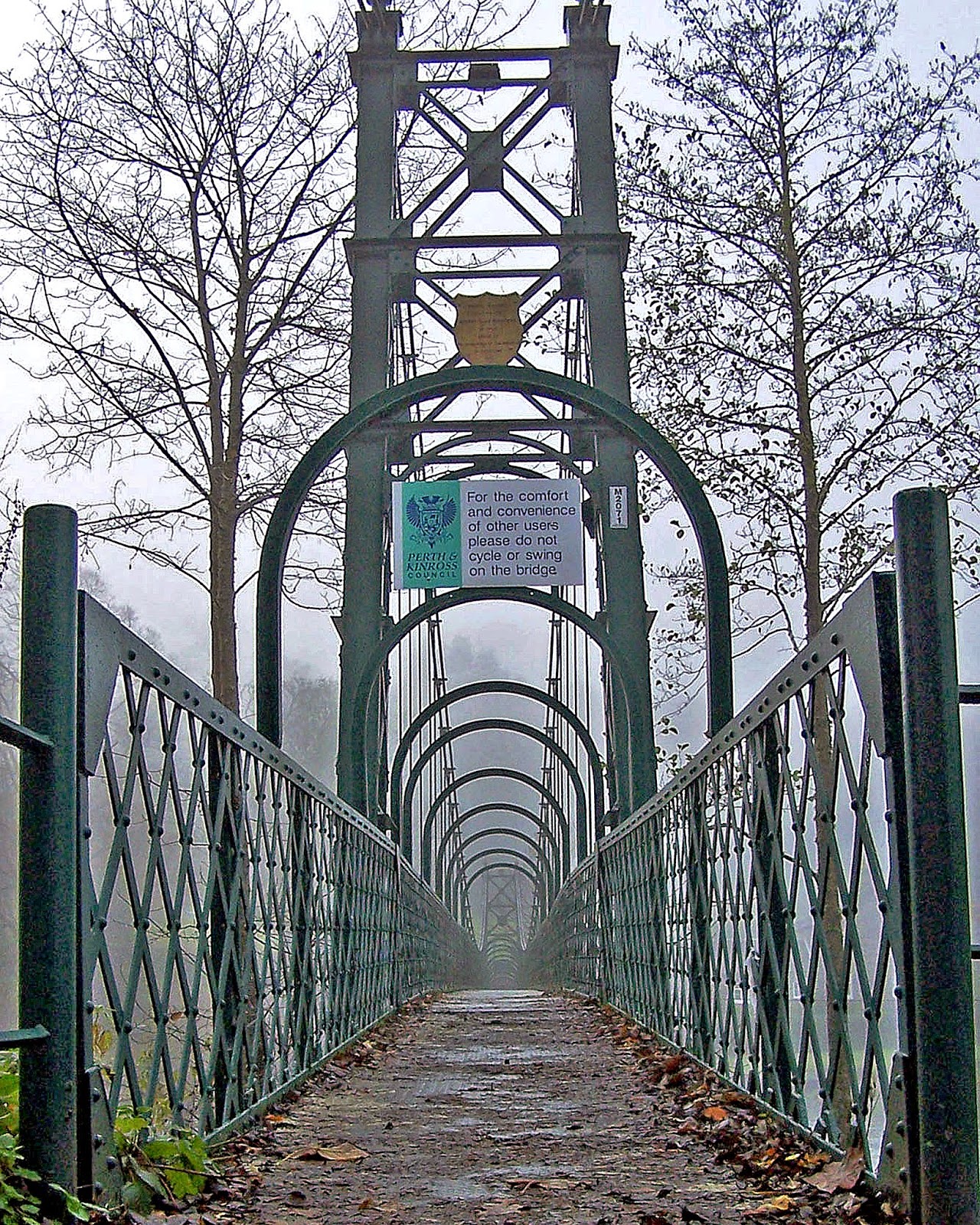
Clunie Bridge Pitlochry Perthshire Scotland

The Clunie Bridge Pitlochry


Cluny Bridge Pitlochry Perthshire Scotland
Misty Morning
I took this picture on a misty Sunday morning while I was attending Dougie MacLean's Perthshire Amber Folk Festival.

The footbridge crosses the River Tummel and was built about 1950 - it replaced an old road bridge that was lost when Hydro Electric built the reserviour and dam here. It is a suspension bridge so will sway while you cross - not great for those of us affected by balance issues.

If you are wondering about the name - it seems to relate to the land ownership at the time the first bridge was built in the 18th century. Clunie itself can date back to a pictish clan. 

Saturday, 3 January 2015

Memoir: My Father: Biography of a Gentle Scotsman

James Hall Reid

My Father - A Memoir and a Tribute


When I was set the challenge "The Person You Most Admire" I discarded a lot of people: William Wallace, Mother Theresa, Ghandi, JFK, Martin Luther, Grace Kelly and on and on. But the one person I just could not get out on my mind was my father. Life threw more than its fair share of problems his way but he emerged a gentle, quiet, well educated man that I miss every day of my life. He was my hero.
This is my tribute to him in poetry and prose. Some of the poetry is in the language of my land, Scotland. Old Scots rich in the cadence that is Scotland.

Copyright

As you can see, the photos are from my family album, duly scanned into digital form. All the pictures and the poetry here are my own.
Please respect my copyright to them and do not copy or reproduce.
Many thanks

Dad with Uncle Bob and 'Meggie' the car

James Hall Reid

1907-1980

Born in Huntly, now Morayshire, Scotland James Hall Reid was the eldest of three. His mother was a nurse at Aberdeen Sick Children's Hospital before she married, and his father had a plumbing business. When Dad was 10, his sister 6 and his brother only 1 year old, their mother died of tuberculous. His father had returned from the Boer War (1902) minus several fingers so found it difficult to work as a plumber. With the death of his wife, he took to drink, lost his business and left most of the care of the children to James, his eldest son. James senior became a postman in Auchinblae a cute little town in The Mearns - now Kincardinshire. I am told he liked that as there were lots of illegal stills in the area who were very generous to their posties. My father never talked about him but my uncle once told me he remembered Hallie (my dad's family name) bringing his father home in a wheelbarrow. What a burden for a child. My father was a confirmed tee-totaller his whole life and I suspect he was afraid he would be like his father if he ever gave into it.
He worked where ever he could to bring some money into the household, and taught himself to read, to do carpentry, plumbing, shoe making, even sewing for his siblings. My uncle spoke often of how Hallie brought him up and despite the constant banter between the pair of them, through all their lives there was a strong bond, immense respect from my uncle to my dad and quiet dignity by my father. My uncle called him The Flower Man because of his love of gardening for Uncle Bob could not see the point in growing anything that couldn't eat.
The photo here is of my father in front with Uncle Bob and 'Meggie' the car.

The Army Life

two Gordon Highlanders

A Highlander in India

It is little wonder that at 15 or 16 he faked his age and joined the Gordon Highlanders to get away. In the army he was a corporal, he played drums in the band, and danced as a Highland dancer at Gatherings. He worked a lot with horses and travelled to Egypt and spent a long time in India. One of my treasures are the photographs he took, processed and printed while he was in India. The backs are a wonderful vignette of life in the army in India in the 1920s. He sent them all back to his father, and still show just how much he loved the man despite all his faults.
Dad left the army in 1930 with an ulcer, a bad chest and a gamey leg from when a horse fell on him.

poetry by AnnMackieMiller

Gordon Highlanders in India
DRUMS
My father was a drummer
in a Highland regiment.
Fancy that, my father!
Strange to think of him marching
and twirling drum sticks,
but I have the photographs to prove it.
He was a Highland dancer too
- and a singer;
I only knew him as my dad;
the soldier in the photo
a stranger with my dad's face.
Mum and Dad on their engagement day
at Turretville Brechin

The Gentle Man

Dad with Micky the dog
Home again in the 1930s Dad worked on various country estates as a gardener. I still love enclosed walled gardens and see him working in them ever time I visit one. He met my mother at Strathcathro Hospital where she was a nurse. She was 18 years younger than him. One tale we heard every time we passed Stracathro was when, while they were courting, Dad threw her lipstick away into the field, saying she didn't need anything like that. I spent years trying to see the lipstick tree.
They moved all over Scotland losing two babies but ending with a family of three, my sister Greta, my brother and me, the after-thought.
Before I was born my mother had tired of the constant moving and they moved into the town of Kirriemuir, a market town in Angus Scotland. He could turn his hand to anything and Dad had a variety of jobs from a cemetery worker, a motor mechanic, a factory jute inspector and finally a boilerman in a jute factory. He hated being indoors and he missed the gardens, so gardening became one of his greatest loves.
His family was the most important thing in his life. He wouldn't have a television in the house until we were quite grown believing it ruined family life. As a family we sang songs round the piano. My mother was a wonderful pianist and Dad a great singer. He used to perform in amateur operas and it was a joy to stand beside him in church, We also played card and board games and made things. We read constantly and listened to the radio - long before modern technology, when I was a teenager he rigged up a speaker in my bedroom to let me listen to Radio Luxemburg, so he could switch it off when he thought I should be asleep.
He loved to tinker with clocks and we had an abundance of them, all lovingly restored. Mum always knew what would come home from a 'roup'. He made rag rugs out of old clothes so the rugs that graced our floors told a story all their own. Dad taught us so many things, it was my dad that taught me to knit (he learned on the ship to India when the sailors taught the army men to pass the time). I was only sorry he didn't teach me the woodworking he taught my brother. On Sundays after church and lunch he and my mother would take us walking, teaching us the names of the trees and flowers. Pity I don't remember them now.
He had the most wonderful child-like love of Christmas perhaps because they had been so few in his own childhood. Some of my most precious memories are of Christmas at home, all celebrated without a drop of alcohol. He would squeeze every present, even those that were not his own and loved squirrelling away little surprises for us all. Many of his presents were hand made or renovated, like the bike he gave me on my 12th birthday. They had had a terrible time keeping me away from his workshop and I can remember sulking when I wasn't allowed near it. The year he won some money on the 'Football Pools' he kept it secret but so proud when he presented us each with a BOUGHT present. My sister got a powder compact, my brother a cigarette lighter and me... a book of course.
He also loved cars. When he got his first car he swelled with pride. 'Meggie' named after my mother is the car shown here. She was dark green - the car not my mother though I suspect mum's love of the colour green had a lot to do with the choice of car.

PHOTOGRAPHS
a poem by annmackiemiller
I hae but twa, maybe three, photos of me and Dad
Ain, snapped in a Dundee street
With me between them, Mum and Dad
But looking back for brither an' sister.
And ain, high in faither's airms
Aged 2 or so I think.
The last?
On my wedding day
still his Bonny Lass
he handed tae anither.
Oh wid I had mair tae mind
his dear face though
it be scoored deep with life's
hard tale and sorrows.

Poetry is copyright to AnnMackieMiller
Mum and Dad on my wedding day

The Funeral by annmackiemiller

Poetry for my father by Ann Miller

I wrote a series of three poems for three funerals, this is my Dad's
Dad,
I couldn't sing.
Not today, not for my dad.
I wanted him to hear my voice one last time
but the words wouldn't pass choking chords
I tried - and failed
Just as I failed to be there before he died
and now the one thing I wanted to do
I couldn't sing for my daddy.
Perhaps he hears me now.

Poetry is copyright to AnnMackieMiller, please do not copy
his last Christmas

Friday, 31 October 2014

Memories of Halloween in Scotland

Halloween in Scotland in the 1950s and '60s

tumshie lantern
Tumshie Lantern - Scottish Turnip Lantern
We never really celebrated Halloween in Scotland - to many staunch Presbyterians it was a bit too pagan for their liking.

 But - we had a few traditions. My dad would make me a tumshie lantern - no pumpkins for us, we made do with a turnip. OK my attempt on the right is a bit pathetic and Dad would laugh. His were always a bit more elaborate and I'm pretty sure he had as much fun as we did with the finished product. Then Mum made mashed neeps from the insides to have with our mince and tatties. Recipe on the way. 

For some they would attach a string to the tumshie so they could carry it and go guising. I suppose that was short for disguising and a forerunner of today's elaborate Halloween costumes. 

Kids would go house to house complete in home-made outfits and with tumshie lanterns. They were expected to do a party trick - sing a song, tell a joke, do a little dance - and in exchange got a few pennies or a sweetie. I wasn't allowed - Mum thought it was undignified and Dad didn't take with the concept of begging when there were so many worse off than us. That didn't stop me sneaking out occasionally with friend Shelagh to go guising to her Gran's in the Glengate. Granny Bruce made fantastic gingerbread men and I was always looking for an excuse to sing. 

Brownies and Guide groups usually held parties at Halloween. Again we made our own costumes, I once spent hours stitching newpaper cuttings onto a dress so I could go as a paper lassie and Shelagh and I once won the fancy dress contest as Beauty and the Beast complete with cardboard snout. 

Games always seemed to involve getting in a bit of a mess. If you weren't bobbing for apples you well trying to eat treacle scones that were hung from a rail by string. With your hands behind your back it was harder than it seems and black treacle found it's way into all sorts of places. 

A simpler time? Probably. A better time? That remains to be seen. 


Thursday, 23 October 2014

Memoir: Introducing the Little Red Town

Kirriemuir panorama by Duncan Stephen
Kirriemuir Panorama by Duncan Stephen under collective commons
Introducing The Wee Red Toun
The Wee Red Toun is Kirriemuir, in Angus Scotland - named for the red sandstone of many of the buildings. I grew up  there in the 1950s.  The country was still reeling, still recovering from World War II.  Rationing was fresh in minds, shortages were common and growing your own vegetable was essential.  But everyone around us was the same; no television for a few years yet (except the Bruce’s next door), no telephone in our road (except ours), and no one with a car, that was something you hired for the holidays.  
Kirriemuir Angus Scotland
The Square Kirriemuir as it looks today
by Ana via collective commons
Kirriemuir was a small market town in Angus, tucked under the glens and supervising the fertile Valley of Strathmore. Its ancient name was Carrou Mor, Gaelic for ‘large quarter’, a way of measuring and identifying different jurisdictions. The town was divided into sections by braes: Northmuir, Southmuir, Westmuir and Kirriemuir itself which I suppose was the ‘east’ part for I haven’t found another.
valley of strathmore angus scotland
The Valley of Strathmore by Jan under creative commons

From the flat Vale of Strathmore at the base, imagine a town build up on levels. On the first elevation was Westmuir and to the south, the Southmuir. To reach the town centre from either you needed to go down then up the other side of a valley cut by the Gairie Burn. The south approach was via Bellie’s Brae and the west, Tannage Brae named for the tanning works that had disappeared before my day.  The town centre had a short high street, a square - the old market place -  and a collection of streets and wynds (narrow lanes) clustered around the old church, the Town House and Toll Booth.  From there was a skelp up a steep hill, called The Roods (another measurement) and all part of what was our extinct volcano. Right at the top was The Hill and the Northmuir.  For us, we knew The Hill as a playground for rolling Easter eggs, running wild and meeting friends, but more of that later. 
There too, behind a tall stone wall, lay the town cemetery.  There was something comforting in knowing your last resting place was watching over the town, across the fertile valley stretching away into the distance and with the hills with the glens guarding your back.
camera obscura Kirriemuir
Camera Obscura on the Hill at Kirriemuir
by Sandy Stephenson via Creative Commons

On the Hill was a camera obscura in the cricket pavilion. I believe it is still there, one of the few left in Scotland. But for us neither the obscura nor the cricket was of much interest, but the cricketers at practice – that was another thing.  In return for fielding for them, we got big glasses of Robertson’s Orange Squash and, of course, the chance to practice our flirting with the big boys.  
Old Kirriemuir from Sandy Stephenson Creative Commons
While I was growing up, there were two factories in the town, descendents of long gone 18th century cottage industries when linen was a staple in Scottish manufacturing.  Proto-industrialisation they call it now, though none would have recognised the term then.  ‘Getting by’ was what they would have said.  Kirrie was well known for its linen and many of the houses still exist, little ‘but and bens’ with one side of the house for living and the other that used to house one or more looms. Up the town they might be two storeys, one for living, one for work.  
In the 18th Century the Gairie Burn had provided water for seeping the stinking linen and our Commonty, - green common land- was used to spread the linen to bleach and dry in the sun.  In our days it was something else entirely but that is something else I’ll come back to.
Factory and housing were build in local red sandstone that named us The Little Red Town, immortalized by Kirrrie-born author J.M. Barrie of Peter Pan fame.   
The town clock and Peter Pan statue Kirriemuir
from Sandy Stephenson via Creative Commons
Time was measured in different ways in Kirriemuir. The chimes of the town clock could be heard throughout the whole town while factory workers were ruled by the ‘hooter’ and, us, by the school bell.

The hooter sounded morning and noon, then again at 1pm and 5pm calling the faithful to work or releasing them for food and rest respectively.  For those working overtime, well they must mark the time themselves.
To the Glens - Kirriemuir is called the gateways to the Glens
Glen Clova by Sandy Stephsson via Creative Commons

Foreword for my Scottish Memoirs

from freedigitalphotos.net
From time to time I will post some of my memoirs - this is the Foreword


FOREWORD
            Let me prepare you for what is to come, dear reader.  This book has no pretensions as a serious history tome.  Instead it is a conversation. Or, perhaps, better say a series of conversations: memories written on a vine leaf that provide a glimpse of life for a young lass growing up in 1950s and ‘60s Scotland. 
If you haven’t met the term before, a vignette is a short descriptive sketch that depicts a single event, an observation, a setting or such. The origin of the word comes from “something that can be written on a vine leaf.” It is a free style of writing, some call it stream of consciousness writing, with each vignette standing on its own. For my purpose here, each is a wee slice of life from my memories of growing up in a small Scottish town called Kirriemuir.  I have changed the names used to protect the innocent, but each vignette is a truth as I saw it.  And if I ramble some, well that is okay, it is MY story.
Was it Churchill who said, “history is another country”?  They had the right of it. I sit here with my laptop on my knee and access to the world a click away, far removed from that 1950s girl. 
So, dear reader, pull up a stool, put your feet up, pour yourself a nice cup of tea and … enjoy! And if you need help with the odd Scots word, there is a glossary at the back.
Old Forfarshire from wiki commons
Kirriemuir lies in the heart of Angus, called Forfarshire in old times. It nests snugly under the Angus Glens and overlooks the fertile Valley of Strathmore. 
Angus on a map of Scotland
How to find Angus on a map of Scotland thanks to wiki commons


Wednesday, 22 October 2014

Dougie MacLean's Perthshire Amber Music Festival

Perthshire Amber

Perthshire Amber 2014
Unfortunately I can't get there this year :( but this is one music festival I can highly recommend. 

Ten days of wonderful music from Scots and all around the world. There are also talks and walks, workshops and open-mikes all in wonderful atmospheric venues in and around Dunkeld and Perthshire - including Blair Castle!

Don't be surprised if you see folk knitting everywhere, in pubs and theatres, cafes or just in the park. It is all part of the Big Knit where people knit squares to make a huge blanket that is raffled at the end of the festival. 

Scotland is beautiful in Autumn and Perthshire even more so.  There is loads to see and do and you will meet hundreds of wonderful people. The festival is very much a family affair and they take great pains to make sure you feel part of the family. 

The final hurrah is held in the smallest whisky brewery in Scotland which is worth a visit all on its own. 

Not sure how many tickets are still available, people come from all over the world so they go quick. Click the link to check. 

Dougie sings Caledonia - a 'little song' he calls it he wrote when he was in France and feeling homesick.


Perthshire Amber music festival
Dougie Maclean

I've been lucky enough to be there and will certainly make sure I go again. I just have to get better organised!

You might like to read about my experiences and see my photos - the two links are in the captions of these photos.

My photo of Dougie in a bar somewhere in Perthshire! 


Blair Atholl Castle Perthshire
Blair Atholl Castle Perthshire - usually hosts at least one concert.